

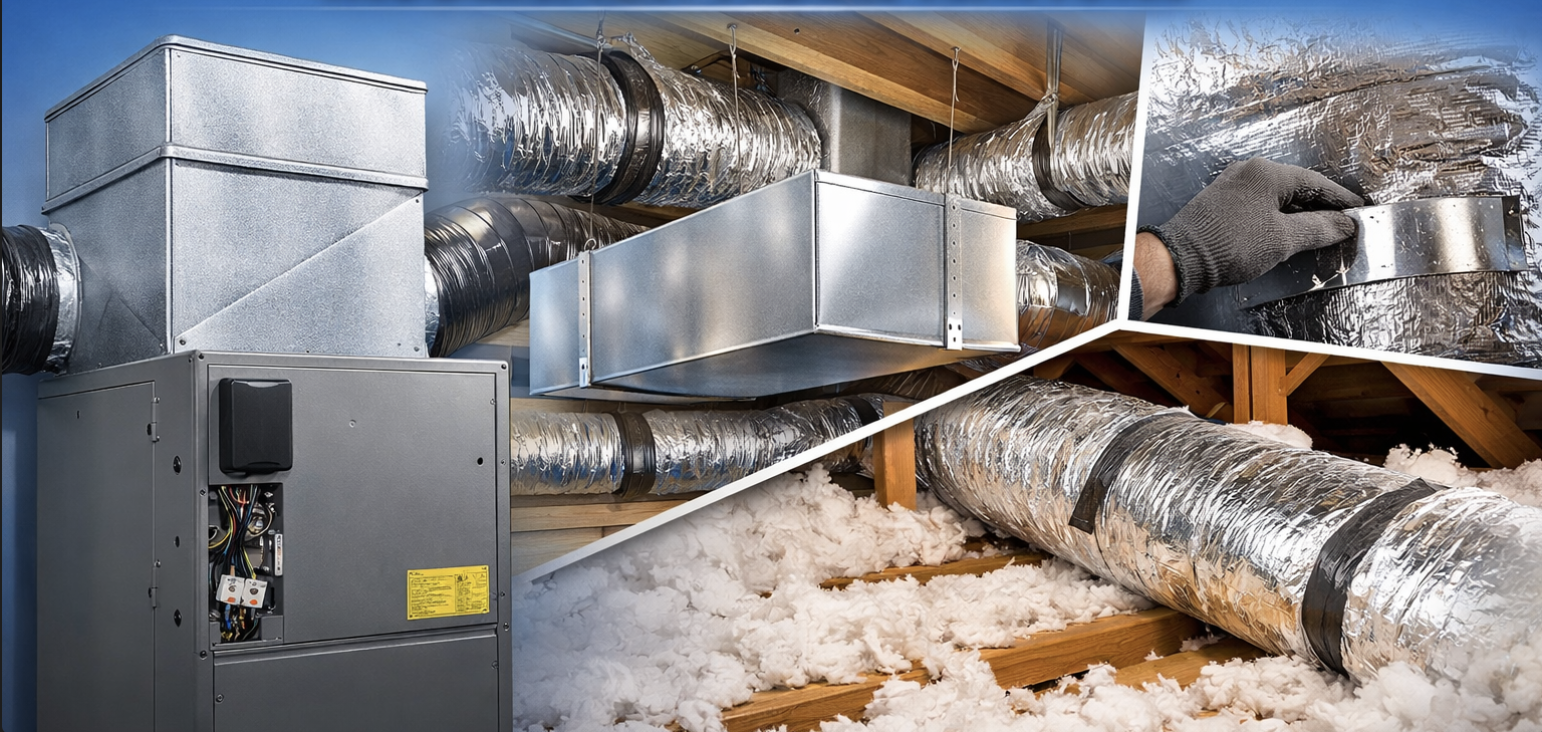
WHEN THIS APPLIES
As a general guideline these smaller duct modification projects with or without insulation should land in the $3,000 – $7,000 range when sold correctly. This ensures the homeowner receives a real performance improvement, installers are used efficiently and the company can support quality workmanship during peak season.
If the scope cannot reasonably reach this level, escalate the opportunity instead of piecing it together.
Use this process when you see:
- Undersized or short supply plenums
- Poor airflow or high static pressure symptoms
- Ductboard “triangle” takeoffs instead of proper wyes
- Crowded attic layouts limiting airflow
- Insulation deficiencies impacting duct performance
If the scope grows beyond light modifications, escalate to a Comfort Advisor.
HOW TO EXPLAIN THE PROBLEM (HOMEOWNER LANGUAGE)
Use simple, physical analogies. Do not over-technicalize.
Core explanation:
“Your system can make the air just fine, but it’s having trouble moving it. Think of it like blood pressure — when airflow is restricted, the system has to work harder. That extra strain shows up as noise, uneven comfort, higher energy use, and a shorter system life.”
METAL VS DUCTBOARD (IMPORTANT)
Set expectations clearly:
“We recommend metal plenums because they hold their shape, seal better, and move air more evenly. They’re also long-lasting and can be cleaned over time, unlike ductboard, which usually has to be replaced once it’s contaminated. From an air-quality standpoint, metal is stable, doesn’t absorb moisture, and is designed to last for the life of the home.”
Internal standard:
➡️ We aim to sell metal plenums ~90% of the time
Duct-board should be used only when site constraints (weird transitions/extremely tight attics) clearly justify it.
SUPPLY PLENUM RULES OF THUMB (FIELD STANDARD)
Use these as baseline guidance:
- 1.5–2.5 ton systems: ~4 ft supply plenum
- 3–4 ton systems: ~6 ft supply plenum
- 5 ton systems: ~8 ft supply plenum
If the existing plenum is shorter, undersized, or immediately necked down, it is a strong candidate for upgrade.
SUPPLY PLENUM – WHAT TO MEASURE & DOCUMENT
EXISTING CONDITIONS
- Length of existing supply plenum
- Width × height (or diameter)
- Material type (metal or ductboard)
- Collar count and sizes
- Immediate restrictions or transitions
EQUIPMENT REFERENCE
- System tonnage
- Evaporator coil dimensions
- Available attic space (length, height, clearance)
FEASIBILITY
- How long the plenum can realistically be built
- Framing, roof pitch, or access limitations
DUCTBOARD TRIANGLES vs METAL WYES
If you see ductboard triangles feeding multiple runs:
WHY IT MATTERS
- Uneven airflow
- Poor balancing
- Increased static pressure
WHAT TO DO
- Determine if a metal wye can replace the triangle
- Measure and document:
- Size of each duct feeding the triangle
- Quantity of takeoffs
COLLARS & TAKEOFFS – REQUIRED INFO
For any plenum replacement we have to have:
- Size of every supply collar
- Quantity of each size
No Exceptions; this is part of the responsibility to be paid your commission.
RETURN SIDE & FILTER RACK CONSIDERATIONS
Capture:
- Furnace model and serial number
- Exact return plenum dimensions
- Available space for a transition
- Clearance for a filter rack – 7″ total for the box
INSULATION CONSIDERATIONS
Insulation frequently supports duct and plenum improvements and should be bundled, not sold as a standalone repair during peak season.
WHEN TO INCLUDE INSULATION
- Low or uneven attic insulation
- Hot or cold rooms tied to duct runs
- High attic temps affecting ducts
- Insulation disturbed by duct or plenum work
WHAT TO DOCUMENT
- Existing insulation type and depth
- Approximate square footage affected
- Areas of missing or compressed insulation
- Whether insulation is being added, leveled, or restored
If duct or plenum work disturbs insulation, restoration must be included.
HOW TO EXPLAIN IT
“Even with better ductwork, heat gain in the attic can still steal comfort. Insulation helps protect the air we’re already paying to move.”
PUTTING THE “V” IN HVAC – VENTILATION
Ventilation tubing is often part of improving airflow and moisture control and can be sold in tandem with ductwork and insulation projects.
WHEN TO INCLUDE
- Bathroom or dryer vents dumping into the attic
- Crushed, undersized, or poorly routed vent tubing
- Long runs with poor airflow or moisture buildup
- When attic work is already being performed
BEFORE QUOTING, CONFIRM:
- Termination type: sidewall or roof – If roofing coordination is needed, referral can be supplied.
- Multiple vents: can they be wye’d or do they require separate holes?
- Routing: clear path for proper slope and damper placement
WHAT TO DOCUMENT
- Number of vents
- Termination location
- Wye’d vs separate penetrations
SELLING GUIDELINES (TECH-LEVEL AUTHORITY)
You can sell:
- Metal supply plenums (preferred)
- Plenum resizing or lengthening
- Wye replacements
- Collar changes
- Light duct rerouting tied to airflow
- Insulation tied to performance
- Exhaust fan tubing to outside
You should not sell:
- One-off, low-impact duct repairs
- Insulation-only work that doesn’t move the needle
- Anything you cannot fully measure and document
If the scope cannot be bundled into a meaningful improvement, escalate.
INSTALLER MATERIAL HANDOFF (REQUIRED)
Duct System Material List Must Be Filled Out. If this information isn’t captured, the job is not ready to sell.
- Plenum material (metal preferred)
- Plenum dimensions and length
- Collar sizes and quantities
- Wye size (if applicable)
- Return transition needs
- Equipment model and serial
- Insulation scope (if included)
- Attic access constraints
If 1 or 2 ducts needs to be upsized to one or 2 rooms, document and add correct collar sizes.
FINAL NOTE
Our goal is not to sell repairs. Our goal is to solve airflow and comfort problems correctly. Metal plenums, properly sized ductwork, and well-placed insulation work together to protect equipment, improve comfort, and make installer time worthwhile.